

We're here to talk about a fundamental shift in how we observe Kubernetes environments. This isn't just about more metrics; it's about getting to the undeniable truth by moving beyond self-reported data to kernel-level reality.
The Observability Illusion: Why Metrics Lie
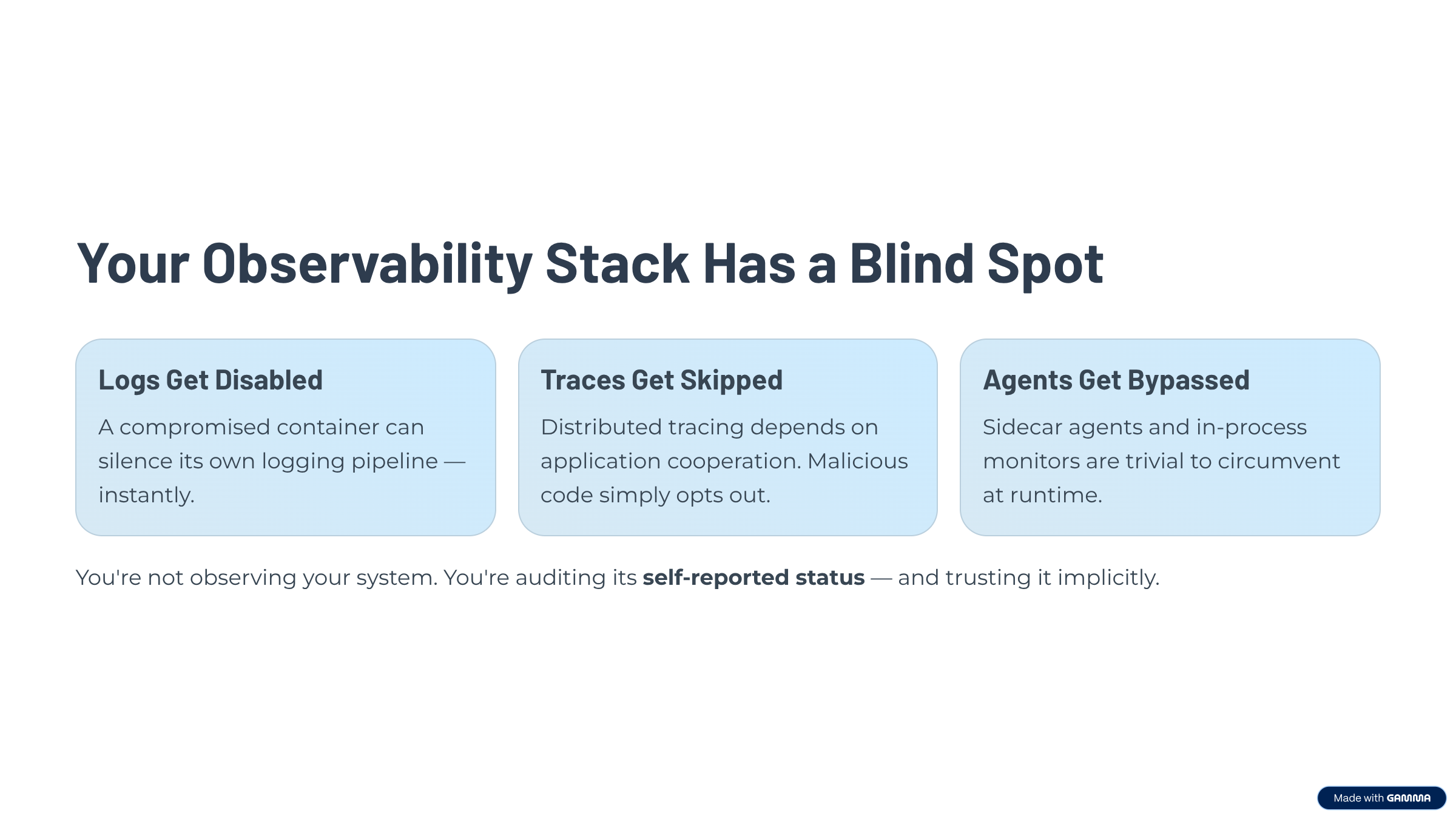
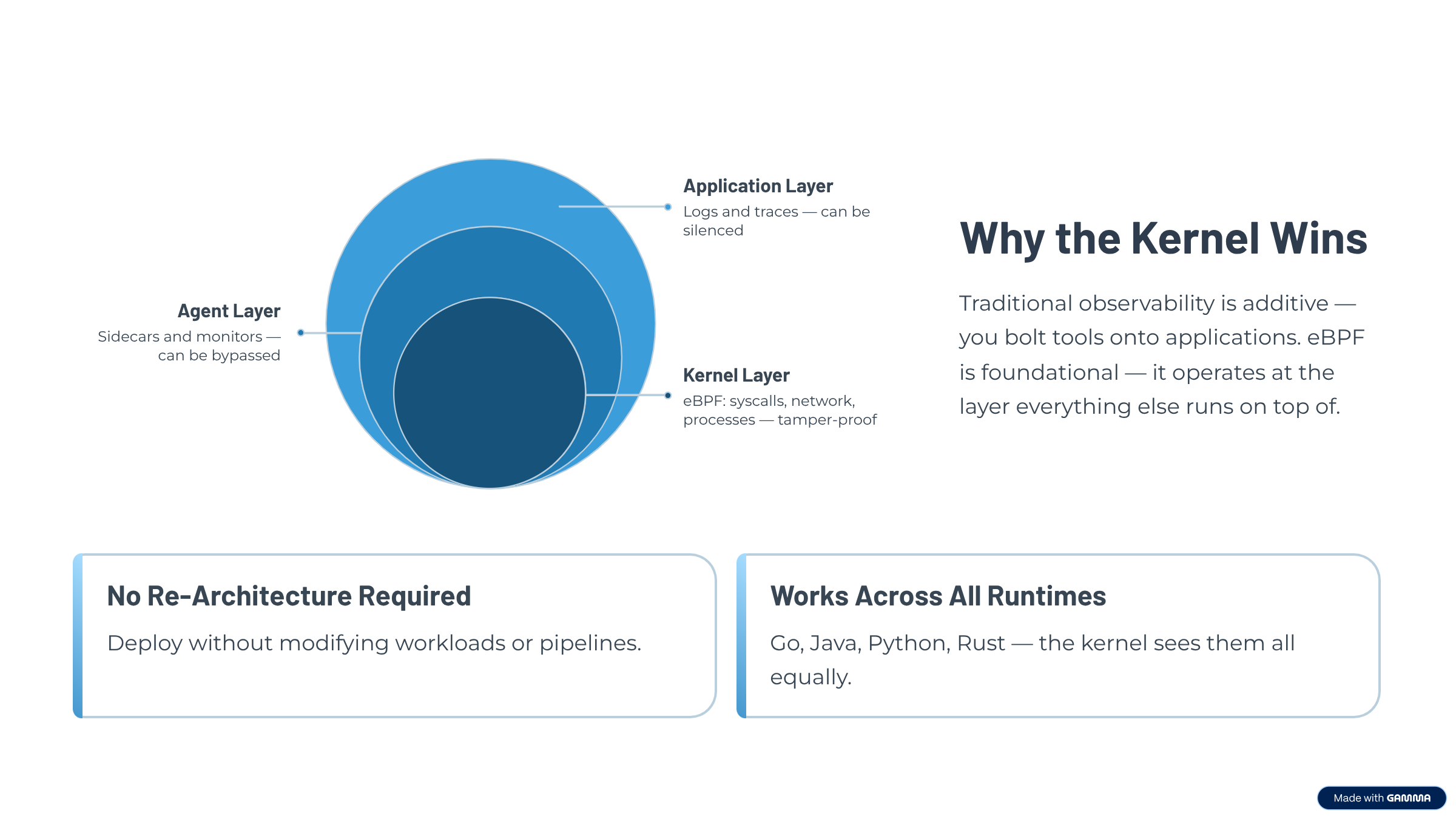
Our current observability often creates an illusion, not a clear picture. Traditional tools like Prometheus, Loki, and Jaeger rely on applications to report their own status. We rely on applications to tell us what's happening, but this creates a critical blind spot—the Self-Reporting Bias.
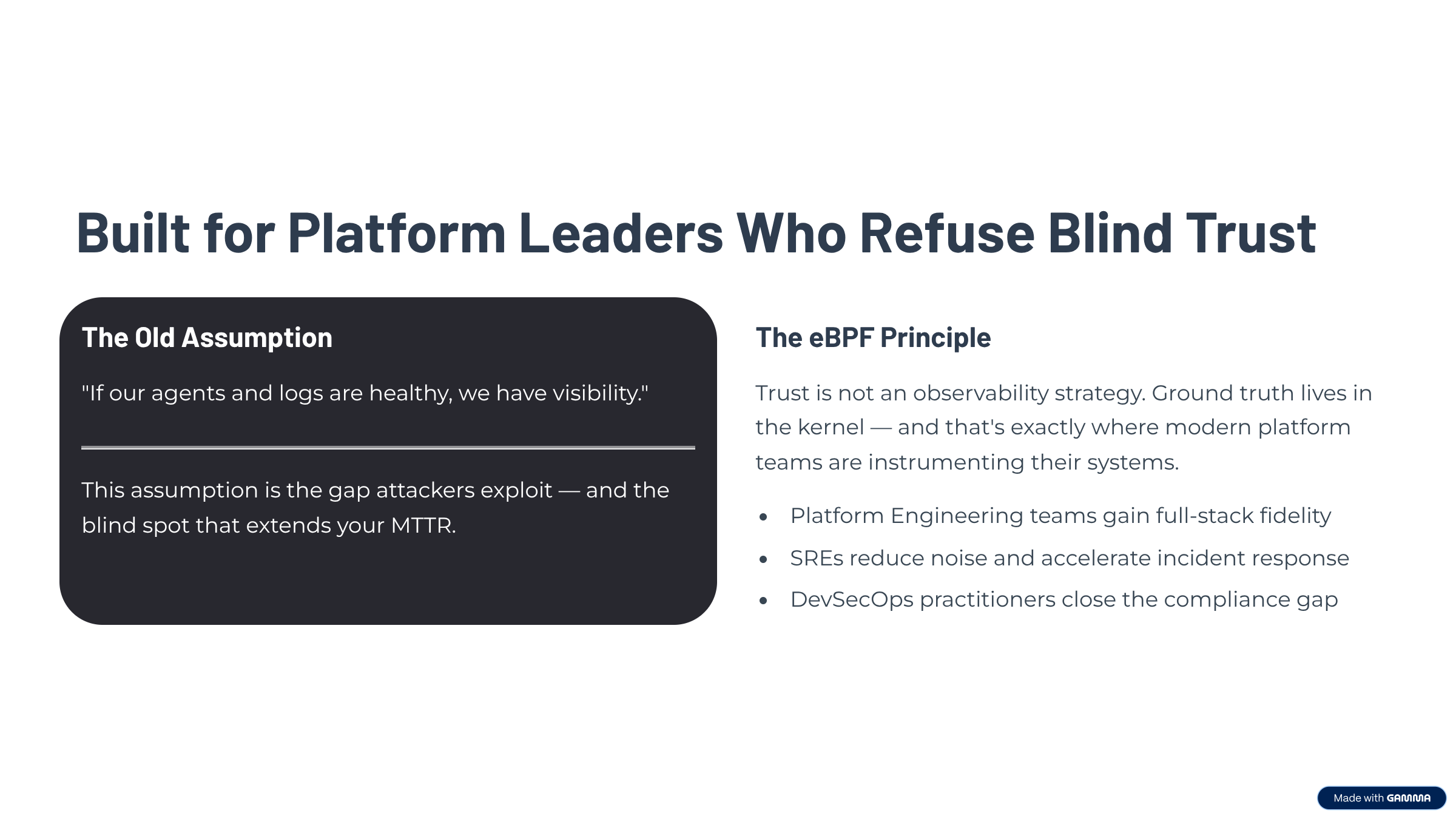
If a container is compromised, attackers can disable logs, skip traces, and bypass agents once they gain access. You are auditing what the system claims is happening, not the raw reality of the execution. If our applications can lie, our visibility is only as good as the application's honesty. Where do we find the truth?
The Source of Truth: The Linux Kernel
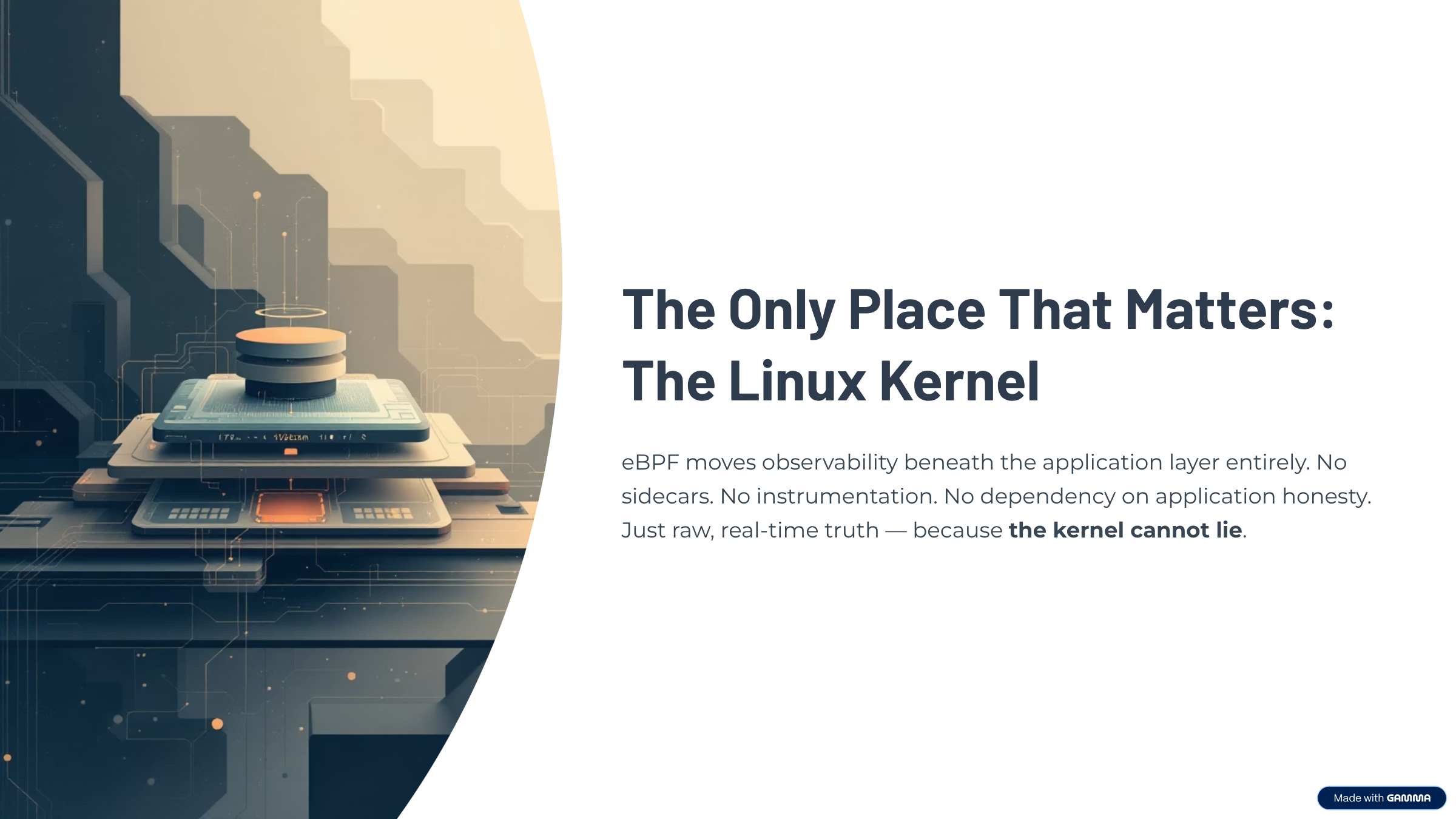
The undeniable source of truth resides in the Linux kernel itself. eBPF shifts observability to the only place that matters: the Linux kernel, bypassing user-space limitations.
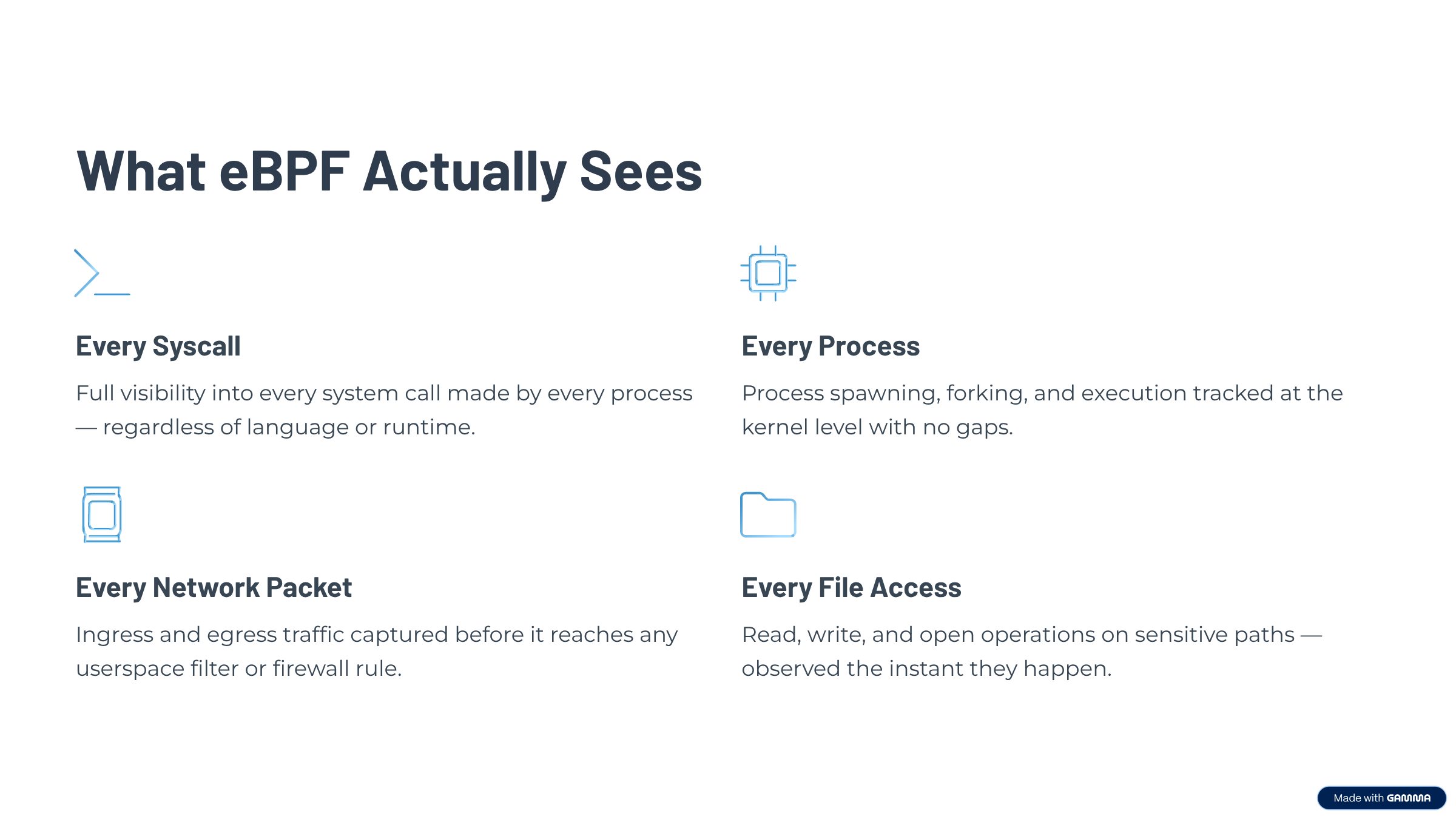
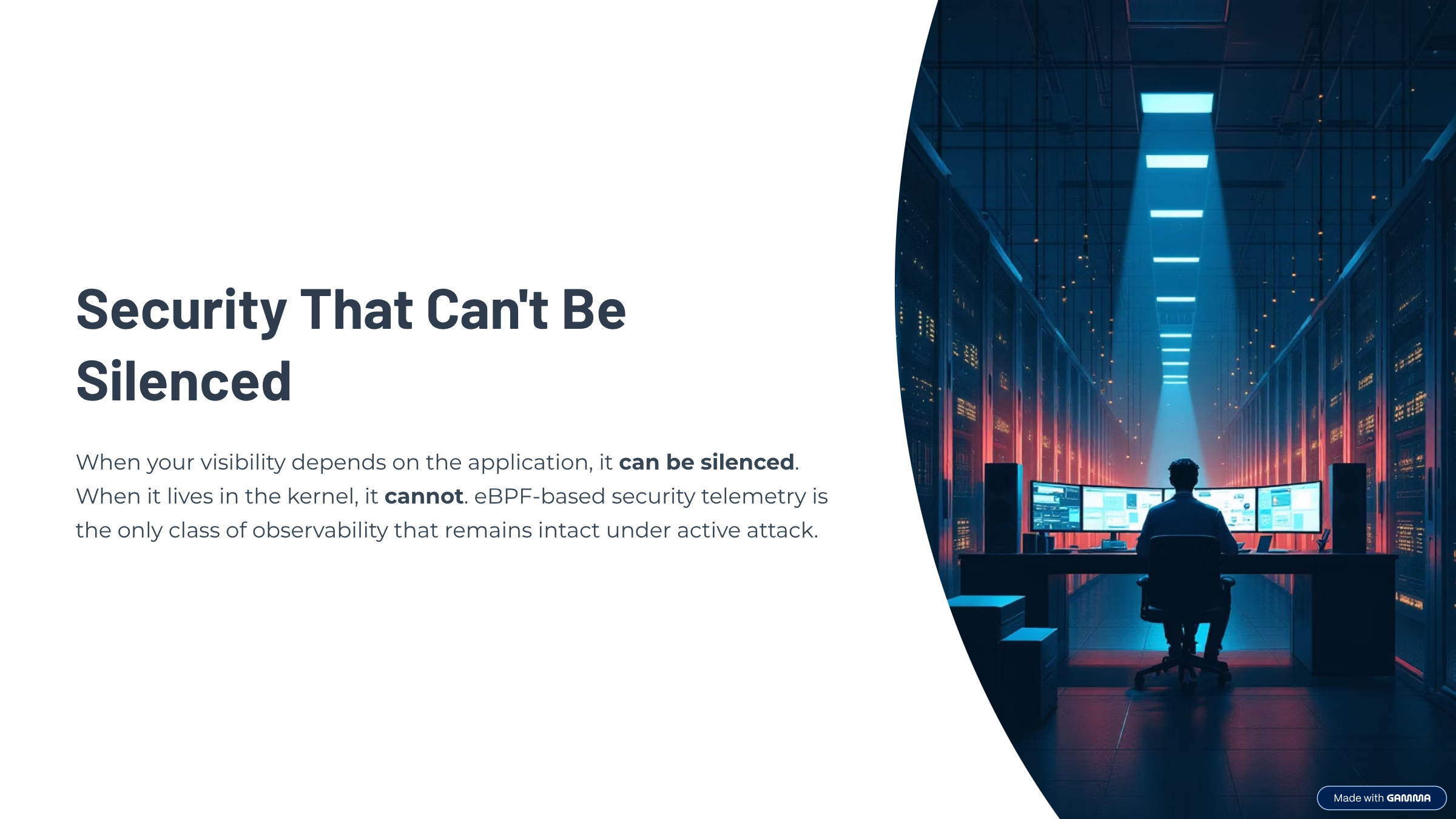
The kernel observes every syscall, every process execution, every network packet, and every file access. Applications can be silenced, but the kernel cannot. It's the ultimate, untamperable record of system activity. This kernel-level visibility is the foundation for true observability—because truth exists in the execution, not the reporting.
How eBPF Works: The Observability Superpower
eBPF provides an observability superpower by allowing us to run sandboxed programs directly in the kernel to observe system events.
- Sandboxed Programs: Run directly in the kernel without changing application code or re-architecting your stack. The eBPF verifier ensures safety and stability.
- Dynamic Instrumentation: Attach probes to kprobes, tracepoints, or uprobes in real-time. Collect metrics, latency histograms, and custom events instantly.
- Zero Overhead: Collect high-resolution telemetry with sub-microsecond latency. Native performance without the resource penalty of side-car agents.
Traditional vs. eBPF: A New Paradigm
There is a stark contrast between traditional observability (using Sidecars and SDKs) and the eBPF paradigm:
- Instrumentation: Traditional requires manual code changes or sidecar injection. eBPF is automatic; it relies on kernel-level attachment without application changes.
- Overhead: Sidecars incur significant CPU/Memory costs for context switching. eBPF brings minimal overhead with native performance and sub-microsecond latency.
- Tamper-proof Nature: Agents are highly vulnerable if the user-space container is compromised. eBPF is protected by the kernel and remains invisible to containers.
- Visibility: Traditional methods are limited to what developers choose to report. eBPF enables full system visibility where every syscall, packet, and process is visible.
eBPF moves observability from a 'self-reported audit' to an 'independent observation'.
Security: The Tamper-Proof Shield
When we talk about eBPF, security is where its tamper-proof nature truly shines. We're moving beyond detection that can be bypassed to enforcement that cannot.
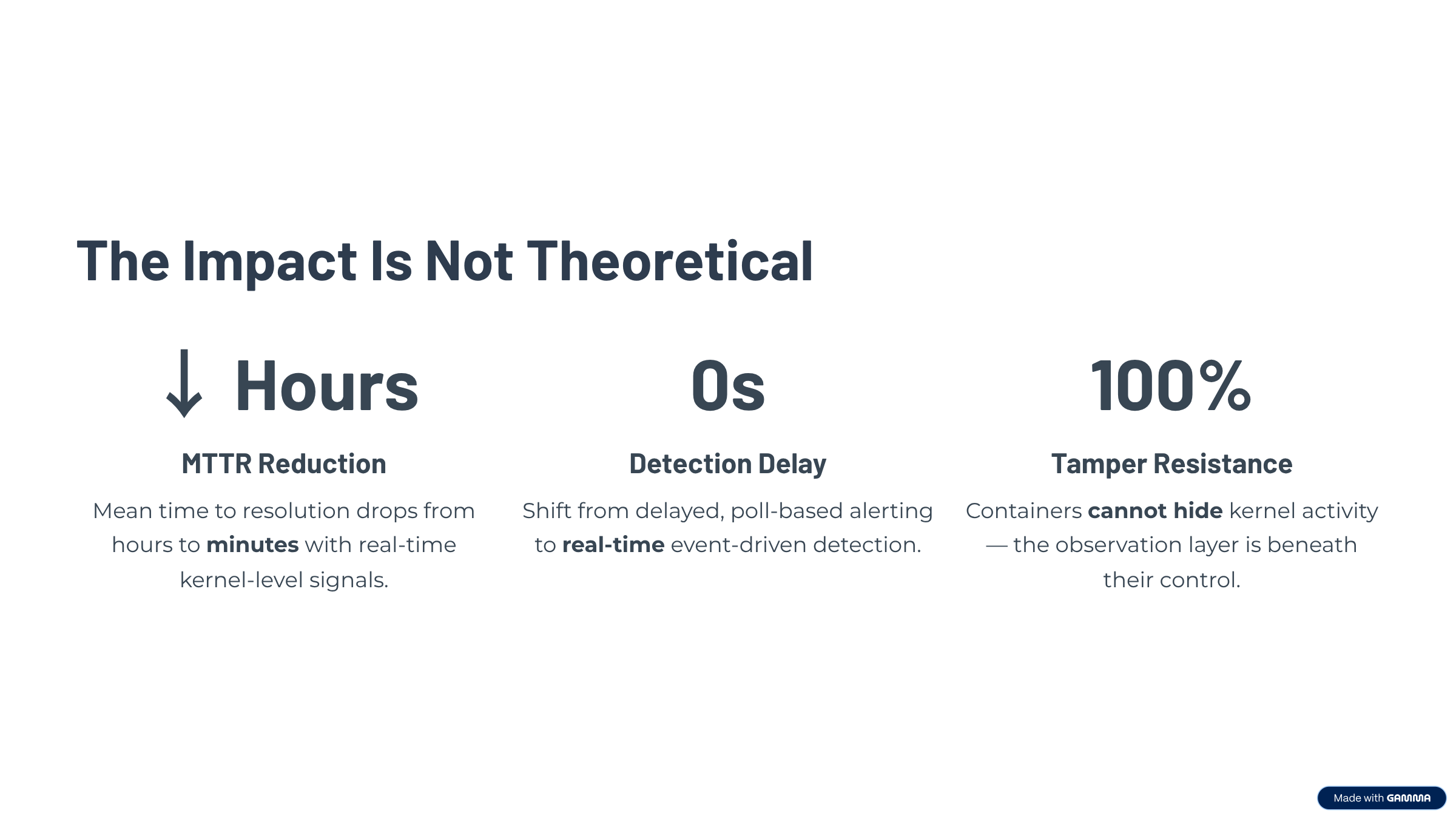
Tools like Tetragon offer eBPF-based Security Observability and Runtime Enforcement. You can identify file-less malware, credential harvesting, and container escapes as they happen in real-time. You can block malicious syscalls instantly, preventing threats before they can execute. Containers cannot hide their activity from the kernel, providing a robust, tamper-proof line of defense.
Networking: Identity-Based Visibility
Building on that kernel-level truth, eBPF revolutionizes networking by providing identity-based visibility. We're moving beyond simple IP addresses to understanding network traffic in the context of Kubernetes identities (labels, namespaces, and pods).
Cilium leverages eBPF to bypass the overhead of iptables, providing sub-microsecond high-performance packet processing in the kernel. This gives you deep flow logs, showing every packet's journey with full context.
Impact: Operational Excellence
This deep, kernel-level visibility has a profound impact on operational excellence:
- MTTR Reduction: Identify root causes in minutes, not hours. By seeing raw system events directly from the kernel, teams bypass the 'log-hunting' phase of incident response.
- Real-Time Detection: Shift from delayed log analysis to instant kernel-level alerting. Detect anomalies as they happen, not when the logs are finally ingested and indexed.
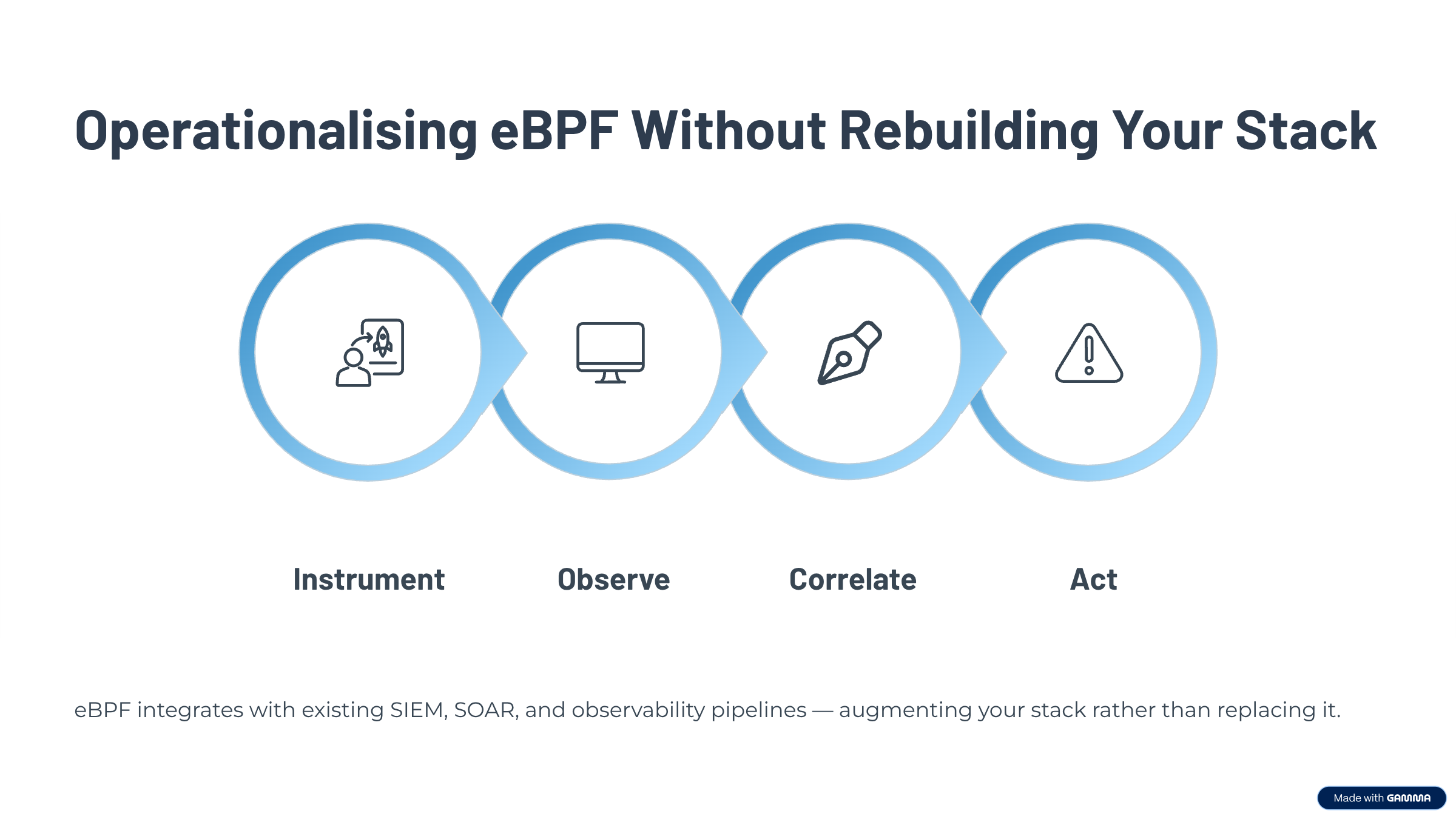
Best of all, you can operationalize eBPF without changing a single line of application code or modifying your existing Kubernetes stack.
Striking the Balance: Safe Adoption
To harness eBPF's power safely, we need to strike a balance:
- Use Trusted Frameworks: Leverage established projects like Cilium, Falco, and Tetragon. These tools handle capability management and program verification for you.
- Enforce Least Privilege: Restrict eBPF loading capabilities (CAP_BPF, CAP_PERFMON) to a minimal set of system-daemon pods using admission controllers.
- Monitor the Monitor: Export metrics on BPF program load times, map memory usage, and verifier rejections to detect anomalies or misconfigurations. This ensures your eBPF deployment remains stable and secure.
Conclusion: Choose the Truth
"The kernel cannot be silenced."
eBPF is not just another tool; it's a fundamental shift in how we observe systems. We're moving beyond blind trust to observing where truth actually exists. Stop operating on blind trust, and start empowering your decisions based on undeniable kernel-level reality.